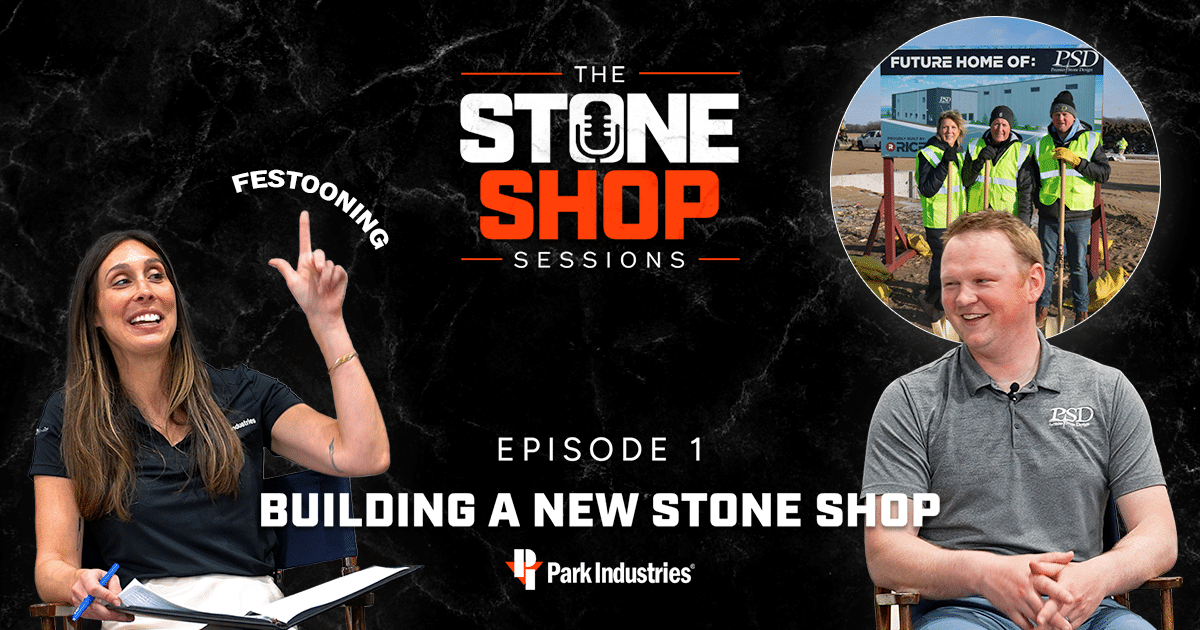
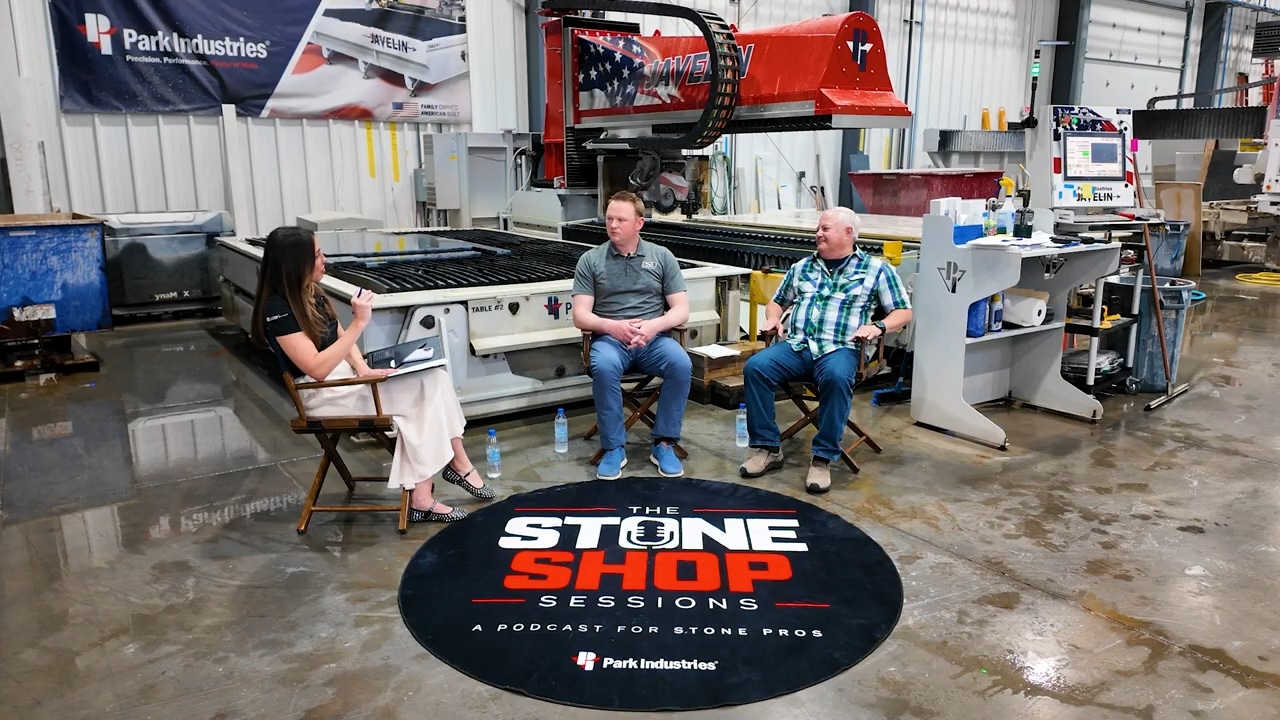
In the first episode of our new podcast The Stone Shop Sessions, Connor Wendt of Premier Stone Design and their longtime Park consultant Dale Schleppenbach share the story behind the shop’s growth — from manual fabrication and their first CNC to a brand-new 19,000-square-foot facility.
Hear what they learned, what they’d do differently, and what it took to build the shop for their next stage of growth.


What You’ll Hear in Episode 1
- Their first leap into CNC and incremental growth
- How automation opened the door to bigger work
- Outgrowing 8,000 sq. ft. and building 19,000
- Designing a shop for flow, efficiency and future growth (plus festooning!)
- What they learned building from the ground up
EPISODE 1 Read the Full Transcript
STONE SHOP SESSIONS
Episode 1 Transcript: From First CNC to Building a New Shop
Read the full conversation with Connor Wendt of Premier Stone Design, Molly Hauer and Dale Schleppenbach of Park Industries®.
Transcript formatted for readability. Timestamps mark the beginning of each speaker turn.
Welcome to the first ever episode of the Stone Shop Sessions, Park Industries' new podcast where we hang out with stone pros and talk shop about industry trends, lessons learned, whatever else comes up along the way. Today I am so excited to welcome our first guest, Connor Wendt from Premier Stone Design. There's really no better first guest that we could have because today we're going to cover the PSD growth story, moving into the new building and have a little bit of fun along the way. I also have our friend Dale Schleppenbach here. He is a Park Industries sales consultant. And so let's get to meeting them. Hi guys. Hi. How's it going? Great. Thanks for joining me on Friday afternoon.
Thanks for having us.
All right, let's get into it. So we're going to talk a little bit about the early days. Connor, take us back to the beginning. When did you first get involved in the family business and what was the shop like back then?
So the shop started by my dad in 2004. And I kind of worked through elementary school, middle school, kind of doing odds and ends stuff through high school and then went to college for two years. And then after college, I kind of went full steam with it.
Came back full steam.
Yep.
Got it. Dale, how long have you been a rep for Premier Stone Design?
Well, Connor's father, Tim, started in 2004, like he had mentioned. And it was an early start with a lot of technology at the time. So it was a Yukon Saw, ProEdge, and a Wizard. And what was really leading at that time was that it was all a wet shop from the very beginning. So they didn't have to have dry grinding like we saw happening everywhere else. And so leading edge, certainly for the time, it was a very, very fun start for sure.
So since the beginning you've been here. Cool. How many kitchens were you guys doing a week back then?
I would say on a good, I guess on a good day, probably one maybe. Probably I'd say maybe 4 a week, something like that. But obviously it was very manually intensive that we were doing.
So in the same vein, think back 20 years. What were things that you considered as normal back then that were bottlenecks that you would look at today and just laugh at?
Yeah, so I think kind of the biggest one is we did all of our sinks by hand, cut them all out on the Wizard, had wooden sink templates. You'd have to cut them all, but then you'd have to then polish them all by hand. So that was such a huge amount of time that it took to complete a job. Right.
That makes sense for the one kitchen a day then.
Right.
Yeah. Who realized, perfect segue, who realized that you needed to go digital first? Was it you or your dad combo?
I'd like to answer that question.
Okay.
They had a Yukon saw and the table was getting out of square. So they needed to replace the table. And I went over to talk to Connor How old was he at this?
Time.
That was probably 20 at that point. 2021.
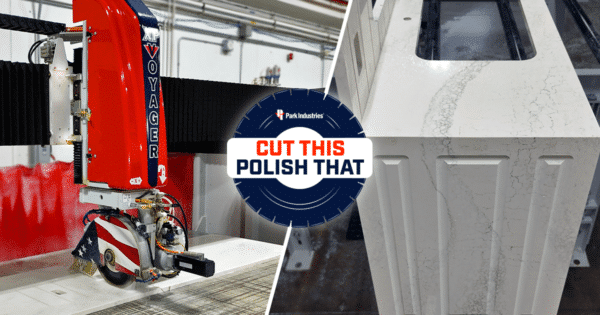
2020. And he said, I asked him, I said, are you gonna take over this business someday? And he said, yeah, that's the plan. And I said, do you see yourself sitting on this stool for the next 10 years? And he said, I hope not. And I said, why don't you and your mom and your dad come over to park and we'll show you a digital way to do sawing with the Voyager. And that was the start of it. So I don't know if it was Tim or if it was Connor who realized going digital was a big deal, but I'm sure it was an interesting ride home.
Yeah, it was, yeah, I mean, it was definitely me that was pushing it.
Yeah, tell me about the demo. What did what did you see?
Night before I was kind of looking at all your guys' videos on YouTube and just kind of showing them, getting them kind of hyped up for it.
Preparing him.
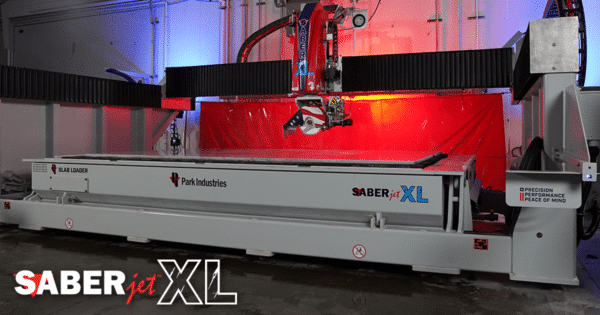
Preparing him, yep. And yeah, so we went to park, had a great demo. We saw kind of two saws, Saber Jet, Voyager. And I think just from that, he obviously could see what that saw could do. I don't think he really fully understood kind of the benefits it could really do. Right, like the hard ROI on it?
So that's what it took for the convincing for him was more of the tangible.
For sure.
Cool. So why did you pick the Voyager? You said you were looking at two different options. Why did you go with the Voyager as your first CNC?
So kind of came down to, so probably the big thing was just the cost difference between the two. So the Voyager, just kind of seemed like a good kind of entry saw for us into the kind of the CNC world. And we're doing a lot of hand polishing at that point too. So that just with the router on the Voyager, it cuts a lot cleaner.
Yeah, I think one of the things that's important to understand too, when somebody's going from a manual shop to going to digital, If you can go incrementally, there's certainly nothing wrong with that. So you don't have to try to go in all in and then it's a crazy expense and then you're nervous about how much money you spent. You can go in incrementally and we encourage that many times because that allows you to see what the next step is going to be. And I think that happened very quickly for you guys.
Totally. Yeah, and we were also at the point where, you know, with the water jet, that's super high production machine. And we weren't at that point in our business where we felt like we really needed that much oomph behind our production. So that's where the Voyager just fit perfectly with us.
The next purchase was the CNC router, the Titan, right?
Yep, So yeah, once we kind of saw what the Voyager could do and my dad was convinced then he was a lot more apt to buy more machinery.
So how long between the Voyager or the Yukon and the Voyager?
So that was about 15 years, I think. We had the Yukon.
So we were running just the Yukon for 15 years and everything else the same process as historically. And then we added in the Voyager. A big question that we get asked at our events is kind of a what comes first, the chicken or the egg situation, just like you were saying, which is like, do you invest in all of the machinery and wait for the business to come? Or do you wait, get inundated with business and then make your machine purchase? And so it's really cool to see that the timeline that you're talking about that transition can be a small window or it can be 15 years, like what's right for your shop.
I think markets dictate some of that. What we see when somebody goes from a manual shop to more digital, just like you guys did, it was a year and a half after the CNC saw that you went to the CNC router. And that's very common that it's a much shorter window to say, hey, we know what it can do for us. We know it streamlines our process. It ends up making the less errors in the process. And it allows you to be more productive and more profitable because you can move more product through the system so much easier, not doing things by hand anymore.
Okay, so you got the Voyager XP 15 years later. You got off the stool in front of that old machine. What else changed immediately when you got the Voyager?
So we had the ability to do digital layouts. So we had the side shot with that. And then we also introduced laser templating. That was a big thing because my dad was doing it measuring full time at that point. So once those two kind of meshed, he really, really saw a solid benefit from it.
So Connor, what something that people underestimate about making that first CNC saw leap?
I would say probably what I noticed was kind of how your whole process is going to change. So kind of the way you were doing it before, you're going to have to do it. You're not going to have to do it completely different, but it's going to change. And you're going to have to adapt with that. You can't be 1 foot in, 1 foot out. You really got to move to one side.
To be more specific, I think When we talk about change in a shop, you have all this capacity to do things that are different than the way they used to be. So you can do Euro seams, you can start doing really high quality shapes. radiuses and stuff that you maybe we even didn't consider before. You can do mitering that you would never have considered before. You can do materials that you never considered before. So just because we've never done porcelain or couldn't do Taj Mahal, now it's available to us and it becomes easy. So that's some of the process things that CNC makes it capable that, and you're talking about making changes that, maybe how we handle the materials and how we put them on a cart and move them out, because there's going to be more volume. So you change. The trickle down.
The trickle down effect.
The trickle down to what happens in the shop. Exactly right.
And, but was there ever a point where you were in that, you know, deciding one foot in and one foot out, was there ever a point where you were like, I don't want to do this. We shouldn't have done it.
I'd say probably in the first week of having a saw for sure. I think that's with anything really. It's new and you know, you're nervous and you've been doing it 15 years the way you were doing it and you know, it was fine, but yeah, actually that first week. And then after that, you really got to got kind of out of that.
Can I tell you about one of the orders that I saw that you guys did was about eighth inch porcelain, all mitered, and you're making these beautiful display boxes. And you had little strips of mitered porcelain and you glued them all together. And it was like amazing. Something you could never have done before. And these were jobs that were just coming to you and you embraced it and you said, yeah, we can do that. And you did. It was totally blown away by the quality of the miters and how you were able to assemble those.
People often attribute moving digital into production capacity, but I think it is important to point out that it does change the type of work that you can do and what bids come and become available to you also. So not just capacity, you can take on more like per an accounting manner, you can take on different with a different price tag.
Yeah, and I would say we definitely got more aggressive within our sales. we weren't afraid to go out and get these jobs that we shied away from, truthfully. And we retained a lot of those accounts even to this day.
Yeah, very cool.
Yeah, and it is a testament to that trickle down change because even down to your salespeople, like, okay, now you're going to go out and sell this really different style of stonework than we're used to. So I'm sure that those rocks continue to get unturned or uncovered as everything moves down the pipeline.
Many times we talk about what segment of the market are you in, and you guys expanded from just doing residential to all these other unique capabilities that you have. And so by diversifying your clientele, you're able to take on other work and moderate the work going through the shop.
And secure your business in times of up for one section and down for another section. Okay, so was there a specific moment where you thought, okay, this is working, we need more?
For sure, yeah. I think the Voyager really kicked that off. And then with the Titan, that just kind of solidified it. And we were just continuing to start getting more and more and more business. So we were kind of full in on Park as far as.
So we had a 15 year gap between the Yukon and the Voyager. How long between Voyager and Titan?
That was about a year and a half.
A year and a half.
Okay, so a much faster lift than the original move. Okay.
And it was perfect timing. And again, incremental moves. So it worked out great.
Right. So then we have a Titan. And again, what was that light bulb moment of we need a new building now?
We were really outgrowing our space. So, you know, we just wanted to give our customers a better shopping experience and our employees as well. Just an overall better environment to work.
When Connor said that he was, you brought up the customer base, I think to really describe that in better detail is that the type of customer and the amount that they're willing to spend and the higher quality that they were asking for and the higher quality materials was a big part of that growth that you had. So from just the general run-of-the-mill kitchen to some really high end stuff that you're able to do because of your growth.
And a space to match it. So Dale, when did you know that they needed more space? At what point?
The space that they had wasn't as user friendly for customers driving in and parking. Walking through the shop was kind of cumbersome where their material was. They did add on to the space because fortunately they were able to get another bay in the unit that you had. But that creates a bit of a problem in just logistics and moving parts around. So the doors in and the doors out, outdoor storage, those are all things that led to what would it be like if you really had real production flow? You come in one door, you move and you come out the other door and everything works like it does in here.
You made the decision, what year was it? To build.
To build? It was, let's see, 24.
And broke ground and welcome to the new world. So introduce us to this new shop. How big is it? What does it have? Tell us all about it.
So we came from our old shop, which was about 8,000 square feet. This new space is about 19,000. So the shop itself is about 16. And then the office showroom space is about 3. So we're about double the height here. So we have about 30 foot ceilings and our old shop was about 15, 16, something like that. So we got to add overhead cranes. That was kind of the must have because our old shop, we were using forklifts and clamps and guys and it just wasn't working out.
So tell me about the process of building. You broke ground in winter of 2024. We were so excited because Craig and I got to nerd out about, we had like the live feed that you gave us. So we would watch the building be built on like super fast forward speed. So we were honored to have access to the building process. But you were involved in the building process also.
Well, before they broke ground, I met with Tim, Tammy, and Connor to talk to the general contractor. And he had his sub-trades, the plumbers, the concrete guys, and the electricians. And they had never built a building like this before. And so they didn't understand why they couldn't do conventional type of construction. They would have wanted to run plumbing under the concrete and all the electrical and everything because they thought that would save time. The problem is you don't know where you're going to drill a hole into the floor in the future and what you might damage. So the festooning was a big deal, even in the building as it was going up. to help the contractor understand, we're just going to hang off the crane with some ready rod and Unistrut. And I kept telling him, Unistrut is my friend. Unistrut's my friend. I had to tell him that a couple of times because otherwise they're going like, why Unistrut? It's because it works. It works. It works well. And you can see it up here. And I think there'll be some shots of that. They can add to it any time for additional water, IT lines, anything can be used in this festooning process that we have here.
And is the shop, we could fit more machines in here? Like you could rearrange and do more machines if you wanted to.
Not even rearrange. It's designed so that the space that's here, we can just move these slabs out of the way and then put the next Titan right in here. So we've designed it for future growth without even having to move anything around. And the festooning allows you just to drop Say festooning again.
Festooning.
Yeah.
Because originally we could fit 2 Titans kind of in our production line. And just kind of the way we have it set up now, we were Javelin and Voyager next to each other. And Dale kind of came to me and he's like, well, if we turn your Voyager and we slide your Javelin over, he said you can actually fit a third Titan on the end all the way down. So I'm like, well, that's Very helpful having you part of the process.
Good.
That's very good. I can see on the wall, and maybe you guys can see this. We came out and put tape on the wall. We numbered the columns, and then we showed where the water and the air and the power were going to drop, so they'd be right perfect for where the machines go. And by being able to do that ahead of time, the electrician, the plumber, and the guys doing the water lines and everything all knew where they had to go right away. And it saved them time. Hopefully that it made a big difference in their lives.
Okay, so you brought some machines over from the old shop and you added a few more toys. What did you get?
So we got the Javelin, we got the Fastback, and then we added the.
Slab vision scanner, and the fastback has an interesting story. So, we did a fastback versus hand polisher with you, and that was your best guy. Yep, and then how many days later did you buy a fastback?
Well, I guess when did we do that video? That was, I don't know.
No. I was on the hot seat for a while there. It was like, they didn't buy one yet, so what am I going to do?
Right, that's the whole reason we made the video, Dale. OK, so then you.
I fired Gilbert and then we got the Fastback off.
Gilbert's still with you.
No, he's not. OK.
Gilbert left and they bought the Fastback.
Because they needed.
A polisher and nobody could keep up with Gilbert, but the Fastback can do, you know, Five times as much.
Right.
We don't want to pay anymore, so we bought a fast track.
So then you originally you talked about having the side shot, but then went to a Pathfinder and now the slab vision. So tell us about that change.
Yeah, so you know it started with side shot on the Voyager. Worked great for what we're doing at the time. You know, once we started getting more jobs, we wanted the ability to program ahead. So that's when we got the Pathfinder. that worked great. Kind of the biggest constraint was just the overall footprint of it.
The size of your shop didn't lend itself to having a really great place for the pathway.
Totally, yeah, we definitely.
It took up a lot of space.
Yeah, we retrofitted it and it's right behind overhead door, so you always had light washing in and you know it worked for what it was and you know that was kind of a big thing moving here. And it was perfect timing. I think you guys just kind of started introducing the scanner as we were in the building process. So I'm like, I have to have that.
Good. What's been the most significant benefit of that machine?
I would say just the overall quality of the images. The customers are It's really cool to hear feedback from them, especially with the kind of interactive 3D model you can do with it. Oh yeah.
They can even get it on their phone and then just be looking at all sides of their kitchen. It's got to be fun for them.
Yeah. it's because when we did that Dekton kitchen video, I couldn't figure out what it was going to look like. And then I looked at the software and I was like, oh, this all makes sense now. So if you're someone who can't visualize a kitchen, then that's a great selling tool to send to somebody.
And it looks cool when it's going across.
It's really cool. Like a giant, like a giant color copier. Yeah. So I have a story that someone told me that one of the first things that you cut on the Javelin was.
Probably a beer bottle top.
That's the story I heard.
That's definitely what it was. Yeah, we We weren't in our shop yet that Park was in here setting up all our machines and it just got finished setting up. It was ready to rip and I'm like, we got to christen this thing. So grabbed the beer out of the fridge and used the blade and popped it off there.
That's awesome. Was the team involved with that?
They were.
Yeah. So good. That's actually the next question. How's everything been working for your team?
Good, I think. like I said, the first kind of week, two weeks we were in here, we really kind of tried to fight our flow. And we all kind of knew that going in. I told the guys, I'm like, hey, it's a new space, we're going to have kinks, we're going to work them out, and it's going to be fine. And now today, we really don't have any kinks at all. And the guys are absolutely loving the new machines, just all the material handling stuff as well.
I was gonna say that if I saw a transition from you guys doing being in the previous shop to here with the same crew. They are so comfortable and enjoy working here so much. I walk in here and everybody has a smile on their face. They are so cohesive and that's credit to you, but also investing in their ability to get product done in a proper way with high quality. They love it. And it just shows in their everyday work. It's so fun to come on in and see what these guys can really do.
Agree. And in an industry where there can That's really impressive. So what you talked a little bit about new types of work. So now with this setup, what is the newest types of work that you're doing? No, our type of.
Work is we're a custom shop, you know, high-end custom. So we do, you know, super high-end jobs. But we also do your, you know, just your average kitchen as well. So, you know, we can kind of accommodate both. Where before we were kind of constrained, you know, if we had a really high end job going, it really kind of bogged us down. Where now we can kind of flip flop and kind of change the shop over for kind of the type of work we're going to do.
So what's your favorite high end piece that you've done?
Favorite high end piece was probably a Taj Mahal kind of stone wrapped hood. We did kind of a kitchen hood vent thing was really, really cool.
Yeah. You were also doing a bunch of showers, I think. When I saw what we do shower surrounds. With shower, a ceiling.
In the shower. Yep, ceilings, four or five walls, various materials. You know, they're not our favorite thing to do, but you know, we'll do them. So.
What was, were there any materials that you were scared of before you had the machines that you can conquer really easily now?
Yeah, I'd say definitely, porcelains. Some of the You know, quartzites, Taj Mahal, Mont Blanc, all those, just with the addition of the javelin, that water jet just rips right through it. So we can really, really push those quartzite jobs out faster.
Good.
I think you have two quartzite jobs on the table right now.
We do, yep. One's for sure Taj and yeah.
Very good.
What's your favorite part of the new shop?
My favorite part is.
I think it's the beer cooler.
Well, that gets hit hard on Friday.
Friday at one, so.
Yep, so, but no, I think just to have kind of a flow where we were before, we didn't really have a really good flow. So now we got a base point and run with that. And just kind of the material handling side is really big to me. just with slab storage. You can have one guy be moving slabs, vacuum lifters, a guy can be unloading a saw by himself, loading the Titan by himself. So that was really important to me and that's one of my favorite things.
I love it. What's your favorite part?
I think seeing the workers having so much camaraderie with each other. And part of that is because of the overhead crane. I mean, one guy can move things around. They're not depending on each other. So if you're focused on finishing a part or doing a glue-up laminate of some miter, you don't have to stop what you're doing and help a guy unload with a forklift and do those kinds of things. So I think also the design of the floor in here sheds water to the outside to the trench drains. and you have a nice high dry center. So you can push carts anywhere without running over all the little schnibbles from stone that's laying around and it makes it very clean. Very easy to keep the silica content down because it's so easy to keep it clean in here.
If someone is not able to move into a new shop right this second, but wanted a piece of advice for like a small simple change that they could make or even maybe a medium change that they could make, what would you tell them?
I would say if you have the room, get a crane. I mean, that's.
Cranes, okay.
Yeah, I would say, and you're kind of saying medium-sized shop, if they're running a manual saw, that the difference that it made for these guys was really incredible. So if you're running a manual shop and you could go into a digital CNC saw like a Voyager, do it. Make that move because the mitering capabilities and all the new product that are coming out require it. So I think that would be a great opportunity for somebody before they end up spending money. A lot of smaller shops are still renting. So you can't put an overhead crane in a shop that you're just renting. So I think that would be the very first step.
Right, yeah. Because not everybody gets to wipe the slate clean and start with a new building, as much fun as it is to talk about. But there are a lot of, there is opportunity for incremental changes. Okay, I'm going to rapid fire style some of the next questions at you. Rapid fire answer also. How long did the process take from idea to reality? 2.
1/2 years.
2 1/2 years. What was the biggest headache?
Probably the permitting and planning. kind of working with the city.
What cost more than you expected?
I would say probably the plumbing in the shop and floor drains and building signage, surprisingly.
That is a funny one for us marketers because I do know how much building signs cost. What was your estimate that you thought it was going to be?
I thought it'd be probably 8 grand and it ended up to be about 30 grand.
I was going to say 28, 30. Yeah, that sounds about right. What took longer than expected?
So we started in, we started digging footings in late November. Being in Minnesota, we thought we could beat the frost and we did not. So luckily they got the forms in. That was a real.
Boring section of the live stream that we watched.
I would just stand here with open field and footing and just imagine what the building would look like.
In the middle of winter in Minnesota.
I have to tell you a quick story. So there was the the shovel opening, right? So everybody's lined up outside and everybody gets a shovel. And the ground is frozen, basically. But they use a front end loader and stirred it up a little bit and put a line of fresh dirt out there so we could have the shovel opening. And then what happened was this is just prairie over here. And so the northwest wind was blowing. And the first people with the shovel, most of us knew what we were doing. And we just tossed the dirt a little bit. But some people threw the dirt in the air and it all came back. Everybody had sand in their eyes. It was crazy. Remember.
The most disastrous simulated opening that's ever happened.
You got some in your mouth? Yeah, for sure.
Okay, what would you absolutely do differently if you had to do it again?
Do differently.
There's not a lot that you would do differently, I don't think. I think one of the things that was a hallmark moment for me was when you were looking at two or three different lots and then you decided this one was a little more expensive, but it was perfectly situated for the retail customer to come in and for truck traffic and everything. And you decided on this lot, even to the extent that I think you have a right of first refusal on the lot behind you. So that makes a huge difference when we talk about now and expansion in three to five years, if that's what the market demands and that's what they want to do. That was a hallmark moment on your part to make the commitment to say this lot, this space, this is where I'm going to build.
This is it. So it felt pretty zipped up. Perfect. Next question then. Did you build big enough or are you already thinking? Sounds like you were thinking, I should get first right of refusal on that guy.
Right. Yeah. So I think we're at, I think we're kind of the perfect size. I mean, you can always go bigger. Everybody wants to go bigger. But as Dale was saying, we designed this building to be able to go bigger. So we have all of our electrical everything stubbed in for a future phase, building designed that way. We have, like I said, an additional lot, so we have plenty of room to do that when we're ready for it.
Good. Walk us through some of the aspects of the new building and why you went with them. Dale, feel free to share any tidbits. Where did you start first with like how to decide how to structure everything?
Yeah, so Dale was a really big part in this too. I just kind of said, hey Dale, you've been in thousands of shops. What do you see? And we kind of got together and kind of what Dale says, basically make an assembly line. Start your flabs in one door, saws, and then finish goods out the other.
Did he draw you a little map and leave it at your desk, like he does for me? Yep, that was your CAD drawing. I've never gotten a CAD drawing.
He put the whole building kind of together with the intent of, you know, what is the space where the trucks can come and go? And then so then where do the doors meet? and make the most logical sense. And then how do we put components in the building that you don't want to ever move, like the air compressor and those features? Water treatment, we shouldn't have to move that again. And so then you design around those features and come up with these kinds of beautiful designs. So credit to you guys for the over at grain, and that allowed for all this wonderful festooning That allows.
Ding, that's just doing count.
And then the drops, where exactly you might need them. And I think one of the cool things was where the hand tools are. You came down, you dropped down, you did everything right there and went back up again. Not that can't be repeated anywhere else. So as you expand, you can repeat and keep on expanding this space. for more growth without having to add on to the building itself.
Yeah, it's a loop system. So all of our air, water, IT is all loops. So that was another insight you gave us. So we should never lose pressure down the line with air or water.
Yeah, the contractors were a little surprised when I told them that you had to loop everything. And they go like, well, why? Because you don't want to starve a machine on the end for water or air or anything else.
Right.
Yeah.
We talked a lot about the shop itself, but let's talk about the showroom because it's quite the upgrade from the old building. The old building, it was like a kind of a smaller enclosed space separate from the shop. And then you came back out and went into the shop. So how has this made a difference for you?
Yeah, so this, the size of our showroom now is, I'd say probably three times the size of our old showroom.
And you have a conference room besides.
We have a conference room now, actual offices. one funny thing I thought of the other week was, during sick season, we'd have an employee come in sick, and all of a sudden, the next person I'd get, next person I'd get, next person I'd get sick because we were so stocked on top of each other. And now we all have our own offices and we don't have that anymore. So, but yeah, we have a great showroom space now with, we have full ceilings in there. That really opens that up. Actual displays, nice displays, fireplaces, stuff like that. So it really, helps our employees be able to sell and it just better experience for our customers as well.
Yeah, definitely. So as a part of this show, it was important for us and I would say as a business always to get our customers and community involved. And so we started what we call the Shop Talk Inbox. and we a couple of months ago went out and asked, does anybody have any advice, questions around the topic of building a new building? So I'm going to give you some and you chime in with what you think. So there was a question from Eric in Utah. Do you feel you should have accounted for more space? If so, how much more and why?
I think that was pretty thought out because we just kept hearing over and over during the building process, even before we even started building was build it bigger than you think you need to be and then more. So the space we have, we have plenty of room here and we've, like I said, plenty of room to grow as well.
Yeah, I would jump in and say part of what we did with the capacity of the Javelin is to say, how do we incorporate 3 Titans in here and then make that a very easy transition? So we positioned the one Titan so that we have room on both sides to position another. And so by looking at that, saying, did they underbuild or overbuild? I think it was just a perfect match to say where they're at now and then how they grow into that space.
And not just like massive extra square footage, but intelligently considered space. Like you could have thrown another 10,000 square feet on, but that wasn't how you did it.
Because where we came from to here, we obviously don't want to overextend ourselves. So we really kind of had to hit that sweet spot.
Yeah, it's got to be a balance.
Good. I'll use an example real quick if you have a minute. There was a shop that was very inefficient. and they were very bogged down and they were building a brand new building that was four times larger. And they were going to take the machines that they had in the same locations and same position and put them into the new shop. And it was a disaster in the old shop and it would be a disaster in the new shop. So additional space isn't always the answer. Additional space doesn't mean that I'm creating efficiency if you don't understand the workflow process. Now I'll move my machines into a flow that allows me to do that.
Yeah, and arguably they could have maybe made that change with just a little bit more square footage, not four times as much and have the same output of efficiency. Yeah. We kind of talked about this, but if you're trying to run custom and production lines, what would you have set up differently or would you stick with the setup that you have?
I would stick with what we have here because we kind of have kind of two different zones over there. So a lot of your custom stuff is going to be mitering, more decorative edges, a lot more gluing. So we have kind of our own separate kind of laminating area for kind of those high-end jobs. And we also have our kind of our standard fab area for just those everyday kitchens.
I think that's kind of a trick question because you're kind of saying production work is 1 quality standard and high-end work is a different quality standard. So how do the two marry through the shop? And I think here What's beautiful about this is that the high-end quality goes all the way through the whole works, right? So production work gets the same high quality standard as the high-end work. Maybe there's a little more hand work involved in gluing and laminating for the high-end stuff, but in the end of the day, all of the material leaving here is highly polished and highly programmed to fit exactly where it's supposed to go.
We had some advice, oversize your electrical and water circulation capacity, run extra electrical drops, oversize conduits, think of work and product flows, analyze your floor drain location and water recycling needs, and plan for more future growth, David in Montana says.
Definitely. Agree.
Anything stand out?
Checked everything off that list.
All those are checked off this list because they have the festooning that allows them to put machines anywhere they want. To use the word again.
To use festooning again. We've never used it up until today for me personally. What about you?
I'm not. Never used it.
I should get that tattooed on my arm festooning right here.
First tattoo for Dale. Advice. Oh, this is your favorite thing. Al in Saskatchewan says, buy the best overhead crane system possible. Tell us about your process.
So our builder kind of recommended these cranes. You know, they've they've they've used a couple of different crane companies in the past and they said these are kind of the best ones. So it does everything we need to do. So we didn't want to overcomplicate it either. So you know, we got your north, south, east, west, up, down. It's kind of all you need. So.
Perfect.
And there's two cranes on the tramway.
Oh yeah, there you go. Advice, have a revenue stream already in place to make all the payments. Don't assume new equipment will bring in the revenue stream in short order. It takes some time, says Darren in Montana. And that kind of goes back to our chicken and our egg. So any input or advice on where is that sweet spot between demand coming in and pushing you into growth versus outward looking and planning for the future?
Totally. Yeah, so we really kind of saw that in our old shop where we were pretty much busting at the seams where we were. But we just still had to make money and especially when going to a bank, you want to have as much money as you can in your account. They want to see growth. So there's kind of a fine line, but we got to the point where we were so crammed in our space, we couldn't do any more production. So we really kind of had to.
We were doing a lot of overtime in that job.
We were, yep. A lot of overtime. Guys were working Saturdays.
And so now you don't have that, the overtime.
Nope.
So now you're more profitable with the same amount of work. That's really important.
Yeah, it's Friday, 1:00 and nobody's around here. So yeah.
So you work 4 tens?
Basically, pretty much.
And then a Friday is just to pick up any extra work if something happened and it didn't get done or a slab came in late or whatever it was. So 4 tens and a Friday and we're sitting here, we should be having a beer.
Right.
We should. Let's see. Advice, check your building lease to see who pays for repairs, says Paul in California. So you did a custom build. So does that apply?
No lease.
No lease.
Scratch that one off.
No lease. My assistant.
Greg.
Okay, here we go. Maybe somebody's going to lease. So good advice for anyone who's going to lease.
Good advice for somebody who's going to lease.
Is there someone out there that does stone shop designs? Ask Chris.
Not that I know of. You probably know. Dale.
Well, and I already had talked about this, that all the sales reps at Park have, we collaborate with each other as well if there's a tricky situation. an existing building with a lot of columns. Maybe it's far up into New England and some old buildings. How do you manage your way around a lot of columns inside a building with not the free space? So we rely on each other. We all have training in process flow and we also have construction in our background. So we know how a building goes together. I know what's in the skin of this thing. I know what's on the roof because that's just standard construction process. And I know why you don't put heated floors in a stone building. You know, all those things are a part of what our recommendations can be.
Did you visit any other shops or go get inspiration from Dale's favorite places?
We did not. We saw a lot on the fabric pierce forums. And then just with Dale's knowledge,
kind of pack it all together.
Yeah.
Good.
Hey, thank you.
All right, so now we're going to talk about what growth actually feels like and what the results have been since we've got here. So looking at the shop today, what are you the most proud of?
I would just say kind of just how better of an environment is just for our employees and our customers as well. It gives them a space to design, feel like a nice new building. They know what they're doing kind of thing. So That's probably the biggest, biggest thing.
I want to point out that I ran out to the showroom and all four of your employees are just hanging out by just by choice. They're hanging out here on a Friday afternoon.
So there are helicats around here.
So that's a great that's a great takeaway. Like they clearly like being here since they're here on their own accord. Anything you miss about the old days? Whip and backsplash by hand?
Not really. I was probably in a little bit better shape just because of all the hand fabric stuff I had to do.
The abs have dropped off.
The abs have dropped off.
That's rough. So if that's your go-to form of exercise, you probably don't buy a fastback.
I'm going to ask another question in a little different way. So when I called and we were trying to set this up, I called you and you were up in Canada fishing. And so I'm saying that it was during the week, so you left your guys, your guys were doing all the work here, and then you could take off and go up to Canada fishing for a week and not even worry that something wasn't going to be done.
For sure.
Right? I mean, that was amazing.
Right. You know, I could take all the credit, my parents would take all the credit for this, but realistically, it's our employees that really brought us here to this space because, you know, You hear it 1000 times with all your employees, you mean nothing. Somebody tells you differently, they don't want to talk on bolts.
One of the things that happened at the last Christmas party was Connor's Father Tim stood up and he gave a little presentation and he talked about how the employees really have a sense of feeling of ownership here because they were the ones that brought this to the forefront. And it's because of them that they're able to really enjoy the fruits of this labor. And like I said, when they come here, their smiles, they're all working together in a team. And it's an amazing thing to see. And that allows you to go fishing when you want.
Yep.
I love that. As often as you want, I think. I don't know. And congratulations on your new baby, right?
Yep. You allowed to take some time off for that.
So now you have some time off being a father. We hear
that. We do hear that a lot about the well-being that in your life that changes when you make that move to manual.
Yeah, I know when we first got our Voyager, it was that summer we were getting married. And up until then, I'm like, well, we can't have a honeymoon. I can't take off. And that completely changed it. We were able to That's awesome. I love that. I didn't know that.
And now take time off for baby. So it's like it's compounding. That's so cool.
That's wonderful.
So we talked a ton about stuff that's gotten easier, but has anything gotten harder in the new building?
I wouldn't say so much harder. I think probably our biggest challenge right now is kind of more remnant storage, which every fabricator listening knows that's the biggest pain in our industry.
So if you're getting a building, make sure, or you're moving or having a lease, make sure you have outside storage. It's just important.
Remnants are kind of the bottom of the totem pole, so they're always going to be there.
It was a problem at the last shop, too, though.
Exactly.
All right. Can you share with us some of the production results that the move has had?
Yeah, so in our old shop, we were doing probably three kitchens a day, I would say. Running one full-time crew, then we'd have a second crew kind of pick up jobs here and there. Now with the move, each crew is probably getting three or four kitchens A day. So 6, 8 kitchens on average A day. So doubled. Doubled pretty much. Which it's really cool to kind of see that. I was kind of skeptical at 1st and then once we actually got things going, I'm like, wow.
What made you skeptical?
I think it was probably just the way we were doing things for so long. I just kind of knew, I guess, in that sense. But then once you actually build a shop for stone production, that really opens it up.
Did you have to become kind of a pseudo therapist for change for your team?
In the first week, definitely. a lot of the guys, like I said, we've had great employees, great retention. So they were used to our way. And then we moved in here. But I think we did a pretty good job of letting everybody know it's new. We're going to work it out. Don't get frustrated. And they've been great ever since.
Good. I love that. I forgot the other thing I was going to say.
Molly, what's the next question?
Beats me.
This is the edit part. Molly, what's the next question?
Molly, I don't know.
Let's do this one.
Is this part of the outtake?
How important was partnership with Park Industries during your growth?
Very big. Like I said, it's not just Dale in here selling us machines. It's him going through the whole process, the design process, even from design of the showroom. That goes a long way. He's not just a salesman. He cares about us and cares about our business
and wants us to succeed. would say to that, I have a great team behind me at Park. So this isn't just about Dale. This is about all the support that I get from customer service and all the guys that are in field service and all the guys implementing and installing these machines, all the trainers. I mean, there's a whole group of people behind me. I feel confident in what I can do because I got an army of people behind me.
Yeah, same story. Like you said, same story for you. Your teams behind you. I like that.
Yeah, we got a great army of people behind me.
Right. Connor, what would you say to 2018, Connor, about your business's future?
Oh, so I've always kind of thought like back then, if I would wake up in 10 years and see what the shop's doing now, how would I react now? So I would say to myself, just keep doing what you're doing. Always grow, always be open-minded, take on new challenges, and you'll be just fine.
Good. What would you say to 10 years from now, Connor?
10 years from now, keep doing what you're doing, really.
That's good. We're staying on course.
Yep. Keep Dale happy.
There we go. Okay, well, let's wrap up to both of you. If A fabricator that's listening is sitting in a smaller shop right now, they're feeling a little overwhelmed and wondering, like, is that growth even realistic? What are you saying to them?
I would say definitely reach out to other shops. You know, if you feel comfortable with that, talk to other shops that you see that you want to get to that point. And then, you know, obviously talk to Park and just say, hey, this is kind of what I want to do. Can I make it happen? And they have such great leadership there.
I guess I would say, don't be afraid. Don't think that this is the end all here. Go incrementally like these guys did and make the next step. And a year and a half later, you'll be so compelled to make the next step, it'll be a very easy decision. And making those decisions, it's like, yep, it's time to go now, right? So it's not like you have to mortgage everything and try to come up with the perfect shop. There isn't really a perfect shop. There's a shop that's very productive and it's very profitable. That's what we want to get to.
Absolutely. We've seen shops on the East Coast that are small footprint, but with intelligent business planning.
Intelligent planning and being able to do that. And they didn't get their all at once either. They went very incrementally and made the step and the step and the step.
So if you had to summarize Premier Stone Design's growth in one sentence, what would it be?
I think it's fantastic growth.
It's fantastic growth.
It's fantastic growth.
This is great. Super awesome. The best. I think after listening to you guys chat for the last hour, it would be to the tune of measure twice, cut once, that, age-old homage where you really did go about pretty much every element of this build with a measure twice, cut once mentality. So like the thought process behind everything, that's what I pick up. Last and maybe most important question, what is your favorite machine?
My favorite machine is probably going to be the Javelin. just the way the water jet can handle a lot of these quartzites that are coming out now, it's it makes it so much easier. And just the overall look of it is looks mean.
Can I ask you a question? Are you going to climb on top of it again? Like it did.
This is the official safety disclaimer that we do not condone climbing on your javelin. Good. All right. Well, Connor, thank you so much for your partnership. I know Dale loves working with you. I am so appreciative of your partnership and we're so excited to continue to see not only Premier Stone Design, but Scotty and your family grow too.
I know. Yeah. No, like I said, it's Park's been a huge part of this build. So all the way from when Dale first came in, talking about getting to CNC until
Yeah.
Any final words?
No, it's just been fun. That's all I can say.
Connor, Dale, thank you so much for being on the show today.
Molly, thank you for the interview. Appreciate it.
This is so exciting. And this is really what the Stone Shop sessions are about, is being with everyday people who are in the business, people who know everything, and then including our community and bringing it all together to chit chat here. See you next time.
Thank you.
Thank you.
Making the Leap to CNC
Premier Stone Design has been fabricating stone since 2004. As the business grew, so did the need to rethink how work moved through the shop.
After years of cutting on a YUKON® Bridge Saw, Premier took a major step forward around 2020 with the addition of a VOYAGER™ XP CNC Saw.
The move brought digital fabrication into the cutting process and opened the door to a more automated workflow.
And it didn’t stop there. Once Premier saw what the VOYAGER XP could do, the next investment came much faster. About a year and a half later, the team added a TITAN® CNC Router, continuing to build out a more automated production process. Today, the shop also runs equipment including a JAVELIN™ CNC Sawjet, FASTBACK® II Edge Polisher, and SlabVision™ Scanner.
More Production. More Possibilities. More Space.
Eventually, the challenge wasn’t just how Premier was producing. It was where they were producing.
The shop had grown beyond what its roughly 8,000-square-foot facility could comfortably support. More equipment, more production and continued growth meant it was time to think bigger.

Premier ultimately moved into a new 19,000-square-foot facility in St. Joseph, Minnesota, creating more room for production, equipment and the next stage of the business. The new shop included major upgrades like:
- Higher Ceilings with Overhead Cranes
- New Machines (JAVELIN, FASTBACK II, SlabVision) with a True Production Flow
- Dedicated Slab Storage & Remnant Yard
- Offices, Meeting Rooms, Much Larger Showroom/Displays
The new facility wasn’t an isolated decision. It was the result of years of changes throughout the shop, starting with that first move into CNC fabrication.
Building for What Comes Next
There isn’t one formula for growing a fabrication business.
For Premier Stone Design, growth came in stages. The move to CNC changed the way work moved through the shop, additional automation increased capacity, and eventually the team needed more room to support it all.

Premier Stone Design’s growth shows how the right equipment, added capacity and more space can come together over time to support what’s next for the shop.
About The Stone Shop Sessions Podcast
The Stone Shop Sessions brings you inside real conversations with stone fabricators about running a shop, investing in technology, solving challenges and growing a business.
Hear what’s working, what they’ve learned and how shops across the industry are preparing for what’s next.